Martin J. Savage
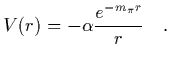
Let us imagine that the nuclear interaction is caused by the exchange of a
spinless particle of mass equal to that of the pion, giving rise to an
isospin independent potential
 ,
a number that we will find
out more about later in the course.
We wish to consider a single nucleon incident upon a single nucleon at rest in the lab frame.
Let the incident nucleon have kinetic energy
 .
Assume that the nucleons are interacting in the
 (total spin=0 channel to compare with data.
 as a function of
 on the same plot as the
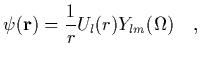
the corresponding wavefunction for the system with NO potential,
 everywhere,
for each different
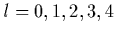 .
 on the same plot.
 for
for incident nucleon energy
between
 and
 .
Plot these phase shifts in degrees as a function of energy.
[NOTE: You will need to use Mathematica for this. The schrodinger equation
should be solved numerically using NDSolve, which you can read about in the book.
The plots should be generated by the same program.
You will need to determine the boundary conditions of the wavefunction at small r
(but not  as Mathematica can't handle that). You will need the value and slope.
]
Also note, that this potential is not a true description of nuclear interactions as you might have guess, but you can judge for yourself how well it works.