


Question: (a) Show that the average intensity of the solar radiation that
falls normally on a surface just outside the Earths atmosphere is
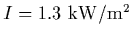 .
(b) What radiation pressure is exerted on this surface, assuming complete
absorption?
(c) Hows does this pressure compare with the Earths sea-level atmospheric
pressure of
.
(b) What radiation pressure is exerted on this surface, assuming complete
absorption?
(c) Hows does this pressure compare with the Earths sea-level atmospheric
pressure of
 .
.
Solution:
The power output of the sun is
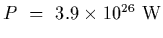 (page A4), and
the mean distance to the earth is
(page A4), and
the mean distance to the earth is
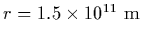 ,
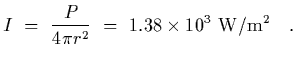
which gives an
intensity at the earth of
,
which gives an
intensity at the earth of
 |
(16) |
 |
(17) |
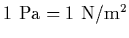 ,
we see that the radiation pressure we have
computed is tiny in comparison to atmospheric pressure.
,
we see that the radiation pressure we have
computed is tiny in comparison to atmospheric pressure.