


Question: Figure 20 (Chapter 41) shows a parallel plate capacitor being
charged.
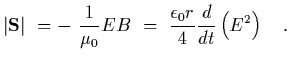
(a) Show that the Poynting vector  points everywhere radially inward
into the cylindrical volume.
(b) Show that the rate at which energy flows into this volume, calculated by
integrating the Poynting vector over the cylindrical boundary of this volume,
is equal to the rate at which stored electrostatic energy increases;
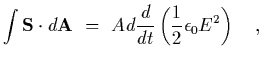
that is
points everywhere radially inward
into the cylindrical volume.
(b) Show that the rate at which energy flows into this volume, calculated by
integrating the Poynting vector over the cylindrical boundary of this volume,
is equal to the rate at which stored electrostatic energy increases;
that is
 |
(10) |
 is the energy density for all points within that volume.
Solution: The cylindrical symmetry of the problem tells us that the magnetic field is invariant under axial rotations. As the electric flux penetrating any flat surface is maximized when the surface is perpendicular to the flux, we see that the magnetic field is as shown in Fig.2, chapter 40.
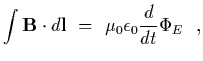
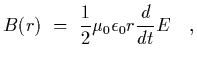
Applying Amperes law in the gap (where I=0), gives
 |
(11) |
 |
(12) |
 |
(13) |
 |
(14) |
 .
.