INSTITUTE FOR NUCLEAR THEORY
News
Home | Contact | Search | News archive | Site Map


|
|
INSTITUTE FOR NUCLEAR THEORY News
Home | Contact | Search | News archive | Site Map |
|||||
|
||||||
|
||||||
|
||||||
|
||||||
Quantifying the Properties of the Quark-Gluon Plasma
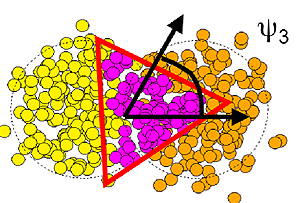
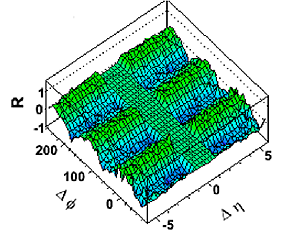
INT program 10-2A ran for a period of 8 weeks from May 24, 2010 through July 16, 2010. Its physics goals are encapsulated in the first sentence of the program description: "The program will focus on quantitative study of hot QCD matter, emphasizing rigorous comparison of theoretical models and experimental data." The program happened at a particularly important time for ultra-relativistic heavy-ion physics: The LHC experiments had started taking data in proton-proton collisions at unprecedented collision energies and were preparing for a first run with heavy ions in November of 2010, with the goal of producing quark-gluon plasma at the highest temperatures every achieved in the laboratory. Experiments at the LHC will provide crucial tests of theoretical ideas developed from RHIC results and, with luck, some surprises. This 8-week INT program provided a valuable opportunity to review thoroughly the full set of experimental results from RHIC, explore the status of their theoretical interpretation and discuss the implications of that theoretical understanding for the imminent LHC program. The program emphasized the importance of a quantitative description of the existing experimental data, as well as quantitative predictions for the LHC. The opening topical workshop on "New Results from LHC and RHIC" helped set the stage by reviewing the progress of the LHC experiments in their commissioning of the detectors with proton beams, reporting first results from 7 TeV proton-proton collisions, and reviewing a broad array of physics issues relevant to the LHC and RHIC programs. Left: illustration of how initial-state fluctuations in heavy ion collisions can generate "triangular" eccentricity, Right: demonstration of "triangular" flow in PHOBOS charged particle Δϕ-Δη two-particle correlations (after the removal of v1 and v2)
While the start of the LHC program provided one point of focus for the program, most of the talks in weeks 2-8 concentrated on RHIC results and their theoretical understanding. Week 2 was devoted to the discussion of the initial conditions of a heavy ion collision and the understanding of those initial conditions in the context of saturation models and the so-called "GLASMA", which will be covered in more depth in the upcoming INT 10-3 program. Three weeks of the program were devoted to the investigation of the bulk properties of the quark-gluon plasma through the application of viscous hydrodynamics and kinetic transport theory (weeks 3 and 4) and to the implications of strong coupling (week 6). The other three weeks of the program were dedicated to hard or penetrating probes of the quark-gluon plasma, with particularly strong attendance in week 5 when we discussed jet quenching theory and modeling and new experimental techniques for measuring jets in the heavy ion collision environment.
A few highlights of the program that illustrate the level of quantitative detail being achieved now
are discussed in the following paragraphs. Discussions during the INT10-2A program brought out for the first time the strong influence of event-by-event fluctuations on the size, shape and orientation of the initial density distribution of the matter created in heavy-ion collisions. A number of talks in weeks 1, 2, 3, 4 and 5 addressed this important problem by showing how fluctuating initial conditions affect the subsequent (hydrodynamic) bulk evolution, how they influence other phenomena such as partonic energy loss and jet quenching, and what experimental consequences might result from these of initial-state fluctuations. One of the most important results discussed at the workshop was the observation by B. Alver and G. Roland (Phys. Rev. C81:054905, 2010) that initial-state fluctuations can lead to "triangular flow". The cos(3φ) modulation associated with the triangular flow can simultaneously explain the so-called "soft ridge" and the side-peaks observed in di-hadron azimuthal angle correlations that had previously been speculated to be evidence for formation of Mach shocks by jets propagating through the quark-gluon plasma. While more experimental and theoretical analysis is required, triangular flow from initial-state fluctuations elegantly explains both of these peculiar features in the RHIC data. The INT 10-2A program was the first large forum at which the resolution of these two key problems in heavy ion physics was carefully analyzed. Following the discussions at this program, it is clear that consideration of initial-state fluctuations is an indispensable ingredient in all quantitative efforts to describe the dynamical evolution of a heavy-ion collision fireball. A second important insight, presented by V. Koch and discussed at some length during our program, is that detailed quantitative analysis of data measured by the STAR Collaboration on charge correlations in Au+Au indicates that these correlations are stronger along the reaction plane than perpendicular to it, contradicting their tentative interpretation as evidence for spontaneous breaking of P/CP symmetry in heavy-ion collisions by the "chiral magnetic effect". Spurred by the discussions at the workshop, papers have now appeared that estimate the magnitude of the correlation signal expected from the chiral magnetic effect, finding it to be at least an order of magnitude smaller than the signal measured by STAR. This drives home the need for a quantitative experimental and theoretical understanding of so-far neglected background effects that must be removed before to the experiments can become sensitive to this topological symmetry-breaking mechanism. R. Chatterjee from Kolkata, India, presented a new theoretical analysis that cast doubt on the interpretation of beautiful recent direct photon measurements by PHENIX as unambiguous evidence for electromagnetic radiation from the quark-gluon plasma and as an (indirect) measurement of its initial temperature. Via hydrodynamical simulations, this analysis demonstrated that, in the measurement window presently accessible by PHENIX, electromagnetic radiation from the hadronic phase is an important and even dominant contributor to the measured photon spectrum. Detailed and highly constrained additional calculations are needed to determine the fraction of measured photons that are emitted from space-time regions of sufficiently high temperature to be unambiguously associated with quark-gluon plasma. Jet quenching is one of the most important experimental results obtained from the RHIC program, but a unique theoretical understanding of the phenomenon remains elusive - largely due to the limitations currently imposed by different theoretical approximations based on the same physical picture. Progress in relaxing these approximations, both in analytical approaches and in Monte Carlo calculations, was a main topic of discussion. On the experimental side, full jet measurements at RHIC and upcoming jet measurements at the LHC are expected to provide a qualitative step forward in the understanding of quenching, and progress towards this goal was also discussed. Week 5 provided an opportunity to review "standard" models for jet quenching, learn about new ideas, and to review technical and theoretical issues in the application of jet reconstruction techniques to experimental data. The afternoon "informal" discussions were used for very effective and valuable head-to-head discussions between the STAR and PHENIX experiments regarding their different approaches to jet measurement and between the different theorists working on jet quenching analyses. Week 7 was used to discuss the problem of quarkonium production and suppression in heavy ion collisions and the state of theoretical understanding of the (yet to be realized) use of quarkonium as a probe of deconfinement in the quark gluon plasma. These discussions went into significant quantitative detail and elucidated the level of sophistication required for quantitatively meaningful measurements and comparison with theoretical models.
Organizational Issues
The INT10-2A program was strongly attended in terms of the total number of participants, but the average time in residence per participant was unusually low. Many participants reduced their original plans to attend for two or more weeks to a single week once they were told when they had been scheduled for a talk. While this allowed the organizers to admit and offer support to additional participants from the relatively long waiting list, the rapid turnover among participants meant that the organizers who stayed for extended periods had to provide the "institutional memory" for the discussion of topics that were touched upon from different angles during separate weeks. This made a comprehensive assessment of the status of the field more difficult than we had hoped, effectively saddling the program organizers with the responsibility to achieve that goal. We responded to that challenge by collecting, at the end of each week, a list of problems and open issues raised by the (very intense!) discussions during that week and combining them into a written document that we expect to post, after some editing and polishing, on the eprint-arXiv as a near-term road map for researchers in our field.
Although the organizers made a conscious effort to encourage women to apply for the program, the percentages of applications received from female scientists and minorities did not exceed their low relative numbers in the physics community at large (especially among theorists), and the fraction of cancellations after admission was, in fact, higher among the female than among the male participants. A possibility to improve on this in the future may be to extend personal invitations to female scientists, with guaranteed financial support, already at the time of first announcement of the program to the community. The procedure presently in place asks the organizers to select participants from a list of applicants who responded to a general call for applications, and to recommend a subset of the selected to the INT for financial support. We were instructed explicitly that the organizers themselves can make no promise of financial support. We do note with gratitude, however, the generosity of the INT director who offered full local and travel support to a young female scientist from India, beyond the previously established budget for the program, and thereby made her attendance possible.
According to oral comments and written exit reports received from the participants, the program is generally considered a big success. The organizers decidedly share this assessment. We have seen at least four papers posted on the eprint-arXiv since the beginning of the program whose authors acknowledge discussions with colleagues during the program for initiating or influencing the reported work.
(INT program May 24, 2010-July 16, 2010)
Reported by: B. Cole, U. Heinz, P. Jacobs, Y. Kovchegov, B. Müller, J. Nagle
Date posted September 17, 2010